














Everyone has gone home. Why haven’t you?
The waiting room is empty. Your staff has gone home. The last patient left a while ago.
But you're still there.
You're finishing notes. Reviewing charts. Completing orders. Wrapping up the documentation that accumulated while you were doing what you actually came to work to do—care for patients.
For many orthopedic physicians, this has simply become part of the job.
But should it be?
The problem isn't that orthopedic physicians need to work faster. It's that their technology should be doing more of the work for them.
You’re Already Moving Fast
Think about everything that happens during a typical orthopedic clinic day.
You're moving from patient to patient, reviewing imaging, documenting exams, making diagnoses, discussing treatment options, placing orders, coordinating follow-up care, and making dozens of decisions along the way.
You don't need technology that adds more steps to that process.
You need technology that can keep up with you.
Yet many EHRs were designed around the needs of the software rather than the natural workflow of the physician. That can mean more clicks, more screens, more repetitive documentation, and more work waiting at the end of the day.
Over the course of a busy clinic, those small inefficiencies add up.
Five minutes here. A few extra clicks there. A note you'll "finish later."
Then suddenly, everyone else has gone home—and you're still working.
What If Your EHR Did More of the Work?
Technology should reduce the amount of work required from you, not simply give you a digital place to do it.
Imagine an EHR that understands how you practice.
It knows your schedule.
It knows your patients.
It knows your protocols.
It knows your documentation style.
It knows the workflows you use every day.
Instead of forcing you to stop, click, search, type, and navigate through the same processes over and over, your technology begins helping you move through them more efficiently.
That's where the next generation of orthopedic technology is headed.
Not toward asking physicians to become faster at using software.
Toward making the software better at keeping up with physicians.
Your Workflow Should Move With You
Keeping up also means recognizing that orthopedic care doesn't happen from one chair in front of one computer.
You're moving between exam rooms. Reviewing imaging. Talking with staff. Checking on patients. Moving throughout the clinic.
Your EHR should be able to move with you.
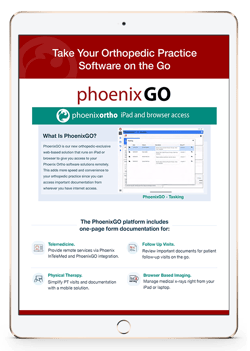
With mobile and browser-based access, physicians can interact with the information they need where the work is actually happening—rather than continually returning to a workstation to catch up.
And when AI is integrated directly into that workflow, technology can take on even more of the repetitive work that traditionally slows physicians down.
The goal isn't more technology.
It's less friction.
Smarter Technology Should Give You Something Back
Every minute saved during the day matters.
Not because you need to squeeze even more work into an already packed schedule—but because those minutes belong to you.
They can mean more time with a patient instead of a computer.
More capacity without extending clinic hours.
Fewer unfinished notes waiting at the end of the day.
And maybe even walking out the door when everyone else does.
That's the real promise of a smarter EHR: not simply helping you document faster, but helping your entire day work better.
An EHR Built to Keep Up With Orthopedics
Phoenix Go was built around the way orthopedic physicians actually work.
As an orthopedic-exclusive, cloud-based EHR, Phoenix Go gives physicians the flexibility to work from a browser or iPad while keeping the orthopedic workflows they rely on at the center of the experience.
And with PoGo IQ, the technology goes a step further.
PoGo IQ brings Cognitive AI into the orthopedic workflow to help physicians navigate the EHR, create documentation, and interact with their system more naturally—while working within the protocols and workflows that already define how they practice.
The physician stays in control.
The technology simply does more of the work.
Because the goal shouldn't be to make you work faster.
Your EHR should be working harder to keep up with you.
Is Your EHR Keeping Up?
If your clinic day regularly ends long after your last patient leaves, it may be time to expect more from your technology.
See how Phoenix Go with PoGo IQ can help you work smarter, finish sooner, and get home on time.
Schedule a 1:1
Get in touch with Phoenix Ortho to learn more about how you can save time, money, and mouse clicks with an orthopedic-specific EHR.