
















For years, electronic health records have all worked the same way.
A physician purchases new software, spends weeks in training, memorizes menus, learns shortcuts, builds templates, and adapts their workflow to fit the technology.
It's simply become accepted that this is "just how EHRs work."
But what if we've had it backward all along?
The Problem Isn't the Physician
Orthopedic surgeons already master incredibly complex skills.
They diagnose subtle injuries, perform intricate procedures, interpret imaging, manage long-term recovery, and make hundreds of clinical decisions every day.
Learning another software system isn't what creates better patient care.
Yet most EHRs expect physicians to become experts at navigating technology instead of letting technology support the physician.
Every extra click...
Every search through a menu...
Every template that has to be rebuilt...
Every minute spent documenting instead of connecting with patients...
It all adds up.
Imagine an EHR That Learns You
Artificial intelligence has opened the door to a different approach.
Instead of asking physicians to learn software, the software can begin learning the physician.
Over time, an intelligent system can recognize:
- Your daily schedule
- Your preferred documentation style
- Your clinical protocols
- The procedures you perform most often
- Your patient population
- Your outcomes and historical data
- Your preferred workflows
The more it's used, the more personalized it becomes.
Instead of starting every day from scratch, the system begins anticipating what you need.
Less Navigation. More Medicine.
Imagine starting your day with simple voice commands.
"Load my schedule."
The information is already there.
"Open today's next patient."
No searching.
"Insert my rotator cuff protocol."
Your preferred workflow appears.
"Generate my office note."
Documentation begins in your own style.
Need to identify every patient who had a positive Drop Arm Test, a rotator cuff tear diagnosis, and arthroscopic repair?
Instead of manually searching records, you simply ask.
Technology becomes less about finding information—and more about helping you use it.
Intelligence That Grows With Your Practice
The real value of AI isn't replacing physician judgment.
It's reducing the friction surrounding it.
As your practice evolves, an intelligent system can continue learning your preferences, recognizing patterns, surfacing meaningful data, and helping organize information that already exists inside your practice.
Rather than forcing every physician into the same workflow, technology can begin adapting to the way each physician naturally practices medicine.
That's personalization at a completely different level.
The Future Isn't More Features
For years, EHR vendors have competed by adding more buttons, more menus, and more features.
But physicians rarely ask for more complexity. They ask for more time.
More time with patients.
More time in surgery.
More time making clinical decisions.
More time at home.
The next generation of orthopedic technology isn't about adding another screen to navigate.
It's about making the technology almost disappear.
When software understands your practice, your workflows, and your preferences, you spend less time managing your EHR—and more time doing the work only you can do.
That's where AI becomes more than another feature.
It becomes an intelligence layer working quietly alongside you every day.
The Bottom Line
Technology should adapt to physicians—not the other way around.
As AI continues to evolve, the most valuable systems won't be the ones with the most features. They'll be the ones that learn how each physician practices medicine and remove unnecessary work from every patient encounter.
That's the direction orthopedic technology is heading.
And for physicians, that means spending less time learning software—and more time changing patients' lives.
Ready to Experience an EHR That Learns You?
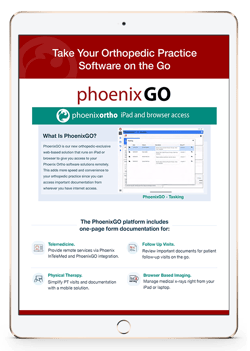
Phoenix Go with PoGo IQ was designed specifically for orthopedic practices with this vision in mind. Rather than forcing physicians to adapt to another complicated system, PoGo IQ continuously learns your workflows, documentation preferences, protocols, and practice patterns to help reduce clicks, simplify documentation, and surface the information you need when you need it.
Discover how Phoenix Go with PoGo IQ can help your practice spend less time navigating software and more time practicing medicine.
Schedule a 1:1
Get in touch with Phoenix Ortho to learn more about how you can save time, money, and mouse clicks with an orthopedic-specific EHR.