















You finish talking with a patient and turn back to your EHR.
Before you can document the visit, you may need to open the encounter, locate the right section, and select the appropriate protocol. Dictation can help you capture your words—but what about the steps that come before them?
For orthopedic practices, that is where voice-driven workflows become especially useful.
Look beyond the note
When physicians think about voice technology, documentation often comes first. Speaking a note can be more convenient than typing, particularly when working on an iPad.
But dictation addresses just one part of the encounter.
There is also the work of navigating the software: opening visits, finding the tools you need, and moving into the appropriate workflow. Each action may seem small. Together, they shape how much attention the EHR requires throughout the day.
A useful question to ask is: How much of your interaction with the EHR involves telling it what you want—and how much involves finding where to click?
Put voice to work throughout the encounter
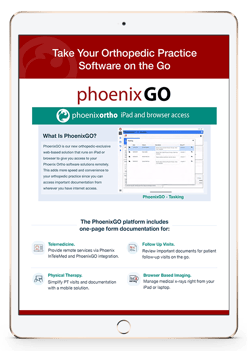
Phoenix Go with PoGo IQ supports voice commands for tasks such as opening visits, inserting protocols, and dictating notes. These capabilities bring voice into more of the orthopedic workflow.
Consider the difference during a familiar encounter. You know which visit you need to open. You know which protocol you want to use. You know what you need to document.
Voice gives you another way to carry out those intentions.
The value is particularly practical when your hands are away from a keyboard or you are using a tablet. A workflow that relies less on navigating menus can make the device more useful in the setting where you actually practice.
Start with one familiar task
Adopting voice does not need to begin with changing your entire day.
Start with a task you repeat frequently. During a demonstration, ask to see how voice works for a typical visit in your practice. Then consider:
- Is the command easy to remember?
- Does it remove a step you repeat throughout the day?
- Does it fit naturally into how you work?
- Can you easily review the result?
The most useful starting point is a task you would be comfortable using again tomorrow.
As voice becomes familiar, you can explore where else it fits.
Keep the physician in control
Voice technology should help carry out your instructions while leaving clinical decisions and final documentation with you.
The goal is a smoother path from knowing what needs to happen to completing the task. That is the practical meaning of moving from navigation to intention.
Schedule a personalized Phoenix Go demo to see how PoGo IQ brings voice into everyday orthopedic workflows.
Schedule a 1:1
Get in touch with Phoenix Ortho to learn more about how you can save time, money, and mouse clicks with an orthopedic-specific EHR.